Ad Astra
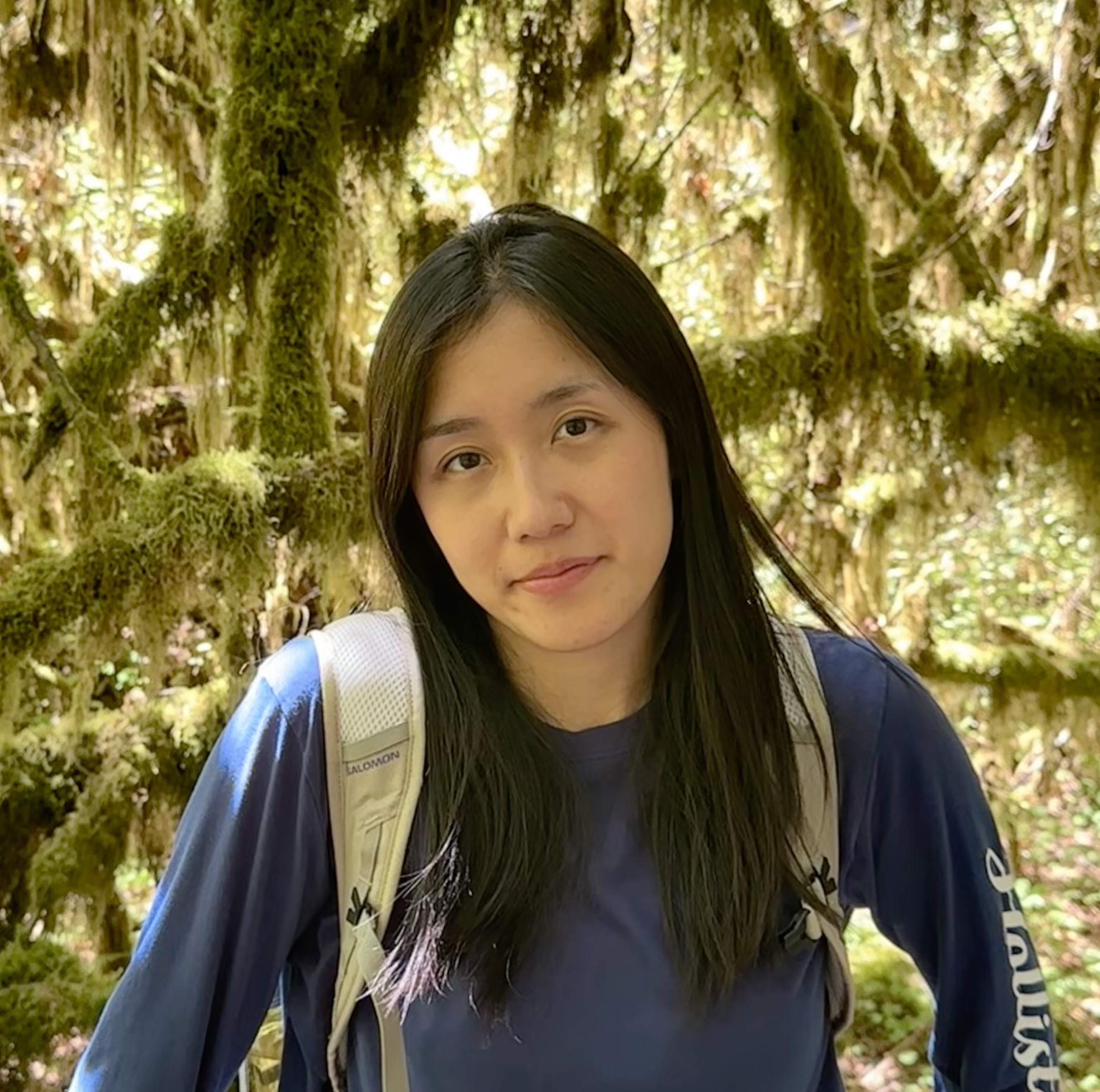
Hello there, this is Jing, a Ph.D. student in Geography at University at Buffalo, advised by Prof. Le Wang. Before this, I received my M.S. in Geo-information and Smart City from Shenzhen University and my B.E. in Surveying and Mapping Engineering from Shandong Agricultural University.
Research Interests
My research focuses on mangrove forest dynamics and coastal resilience through remote sensing and spatial analysis. Specifically, I am interested in using multi-source satellite imagery and geospatial modeling to characterize mangrove species composition, canopy condition, disturbance, and recovery, with the broader goal of supporting coastal ecosystem monitoring and risk assessment.
Recent Research
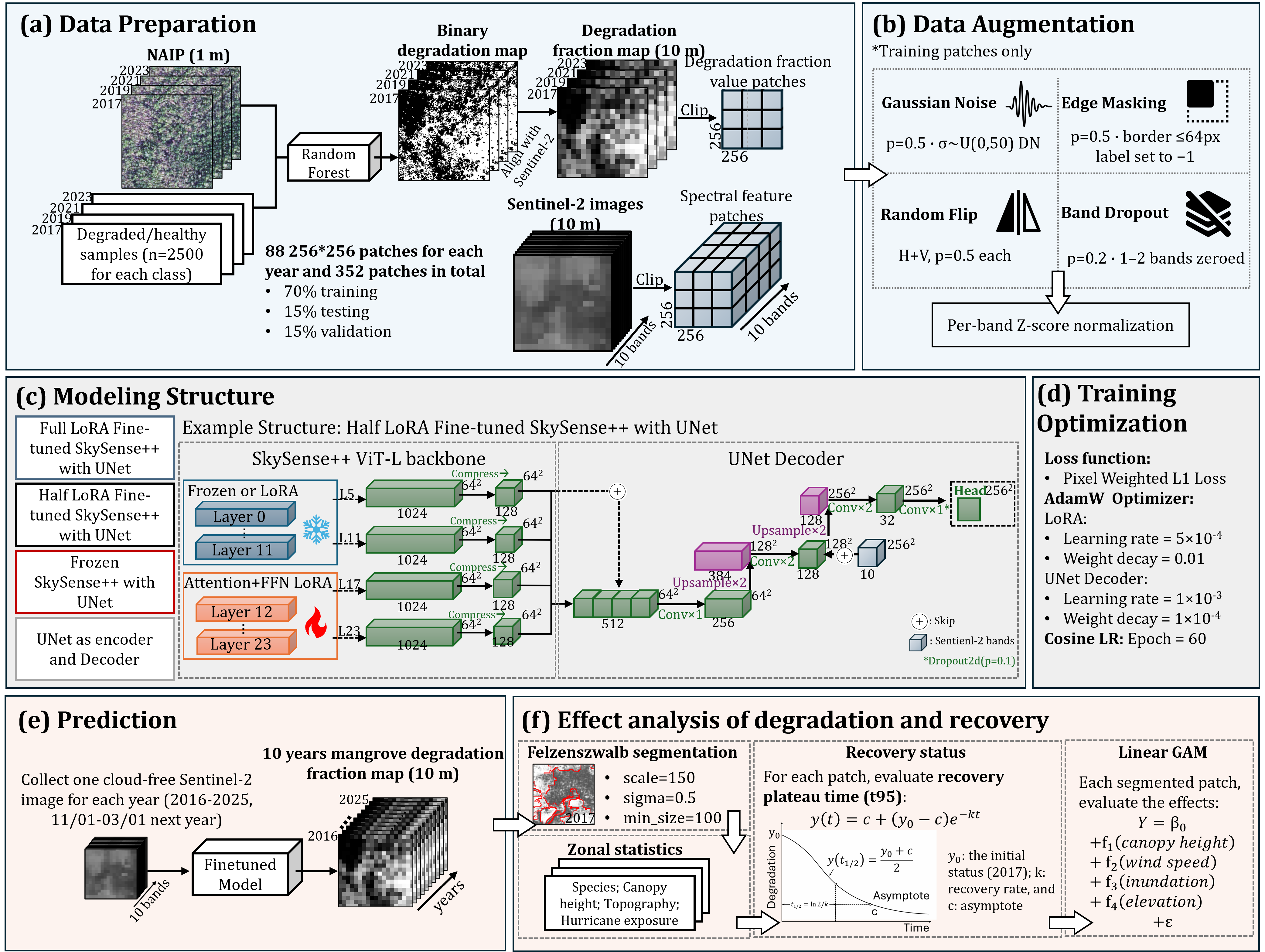
A cross-scale foundation model framework for annual regional mapping of post-hurricane mangrove degradation and recovery (under revision)
This study develops a cross-scale framework for annual mapping of post-hurricane mangrove degradation and recovery across South Florida and the northern Caribbean from 2016 to 2025. High-resolution NAIP-derived degradation labels are used to train a SkySense++ remote-sensing foundation model with a U-Net decoder. The resulting annual maps are then used to examine how species composition, canopy structure, topography, wind exposure, and inundation shape mangrove degradation and recovery trajectories.
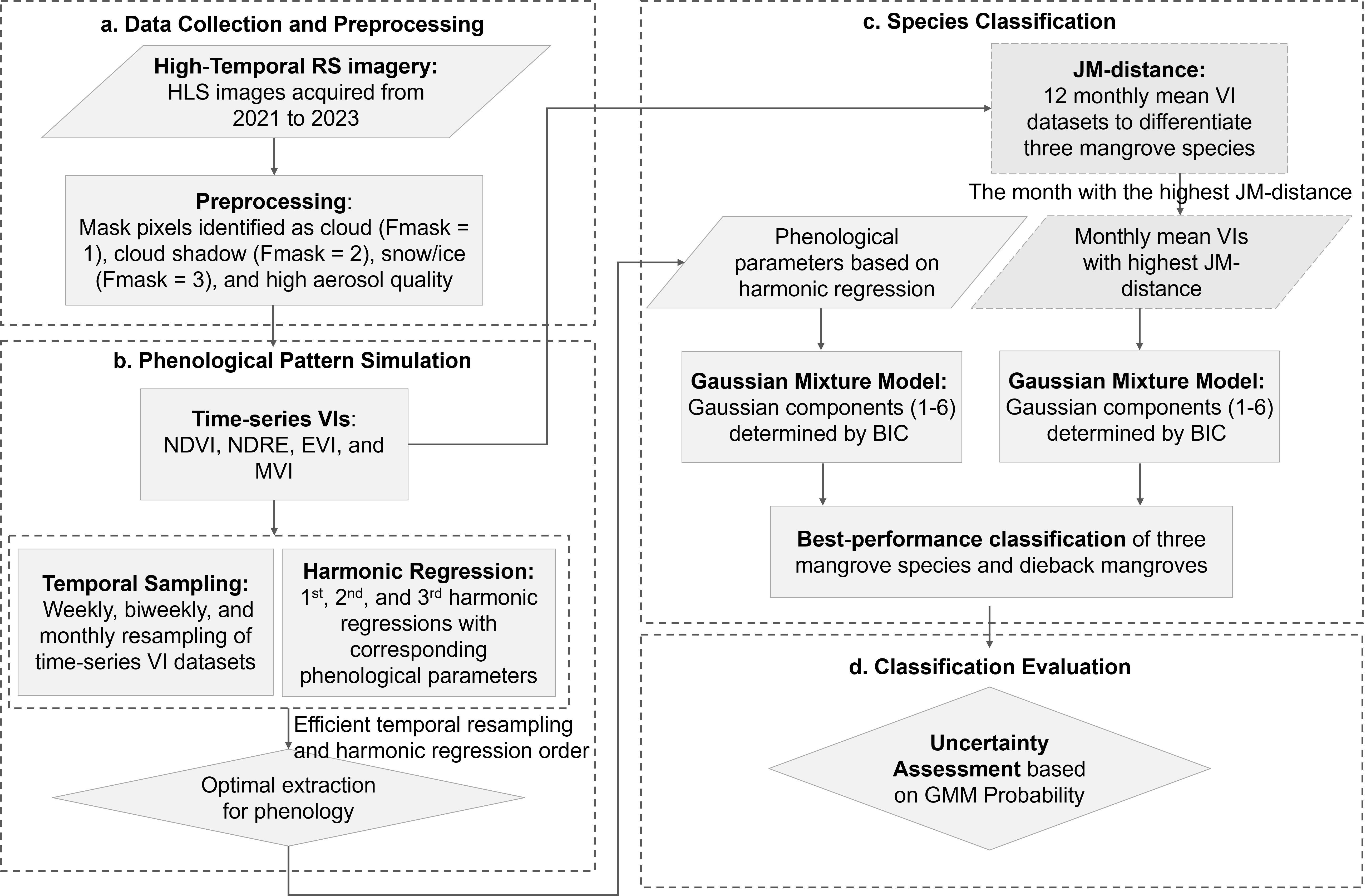
Phenological feature extraction for mangrove species mapping using high-temporal HLS-2 imagery (under revision)
This study develops a phenology-based framework for mapping three dominant mangrove species, Rhizophora mangle, Avicennia germinans, and Laguncularia racemosa, together with dieback areas using high-temporal-resolution HLS imagery. Second-order harmonic regression is applied to vegetation-index time series to derive phenological parameters, which are integrated into a Gaussian mixture model for probabilistic classification and uncertainty assessment.
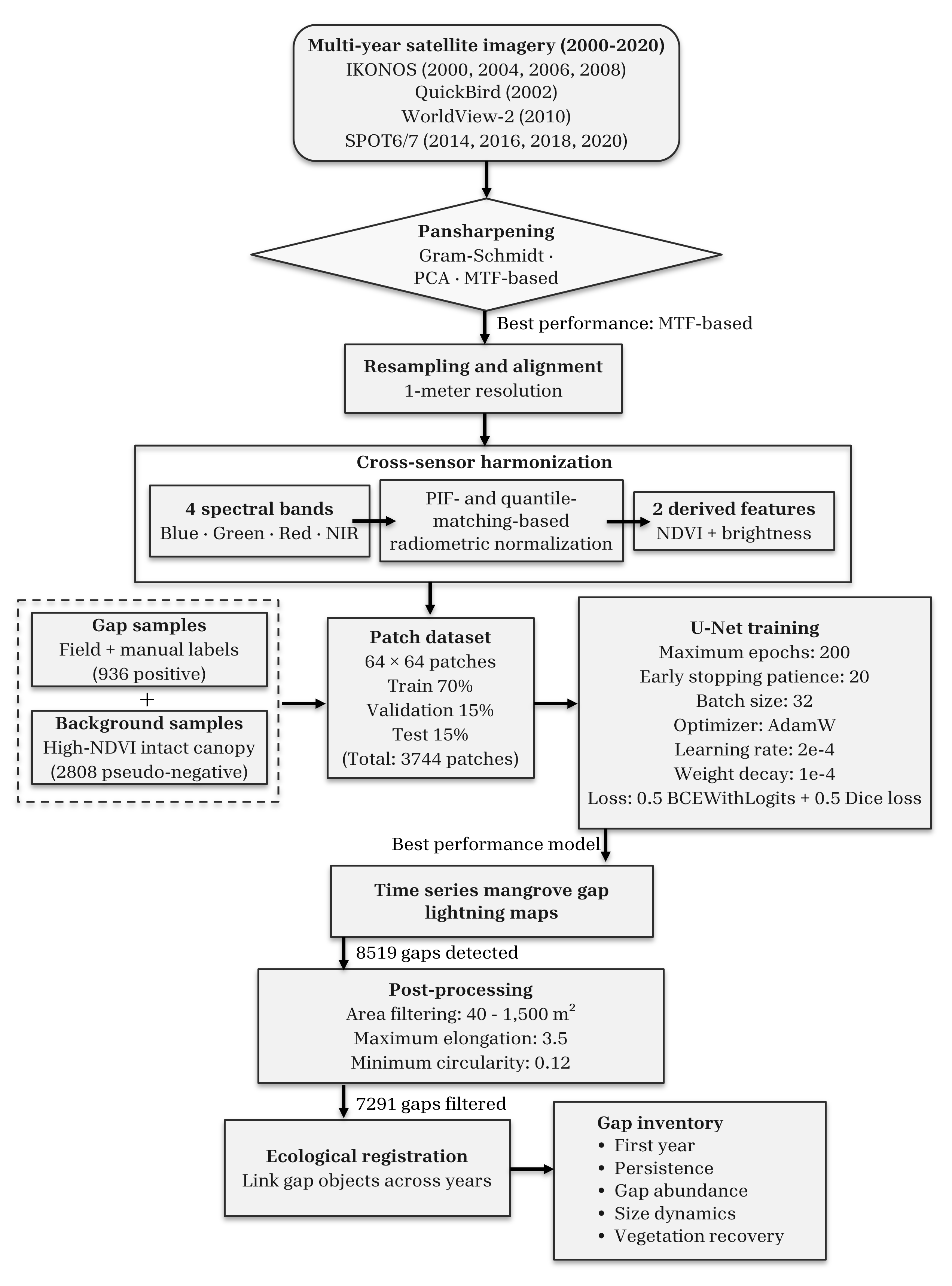
Tracking lightning-induced mangrove canopy gaps in Panama using multi-temporal remote sensing (under revision)
Lightning-induced canopy gaps play an important role in mangrove regeneration and forest structural dynamics, but their long-term recovery is difficult to observe consistently. This study combines multi-sensor high-resolution satellite imagery, radiometric normalization, U-Net segmentation, and object-based temporal tracking to map mangrove canopy gaps in Panama from 2000 to 2020 and reconstruct gap formation, persistence, re-observation, and recovery.
Modeling strategies and influencing factors in retrieving canopy equivalent water thickness of mangrove forest with Sentinel-2 imagery
This paper maps mangrove canopy equivalent water thickness using Sentinel-2 imagery at the reserve scale and compares machine learning, radiative transfer, and hybrid modeling strategies. It further evaluates how species distribution, slope, elevation, and distance to dam influence the spatial distribution of canopy water status.
Mapping seasonal leaf nutrients of mangroves with Sentinel-2 imagery and XGBoost
This study compares machine learning models for estimating mangrove leaf carbon, nitrogen, and phosphorus from Sentinel-2 imagery acquired in spring, summer, and winter. The best-performing model is then used to map seasonal leaf nutrient dynamics from 2017 to 2021.
Beyond Research
Outside of research, I enjoy tennis, basketball, reading novels, and exploring new ideas. Some of my favorite writers are Elena Ferrante and Albert Camus. I am drawn to evening glories, forests, the ocean, and the curiosity that keeps learning alive.